
Quantitative Aptitude
Quantitative Aptitude for Banking Exams (IBPS, SBI, RRB)
Quantitative Aptitude tests how quickly and accurately you can solve number-based problems. In banking recruitment exams such as IBPS, SBI and RRB, it is usually a scoring section, because the questions follow familiar patterns and improve with practice. This page explains what the section covers, how to prepare, and shows worked examples.
What the Section Covers
The exact pattern changes between exams and years, so confirm it in the latest official notification. The topics that appear again and again are:
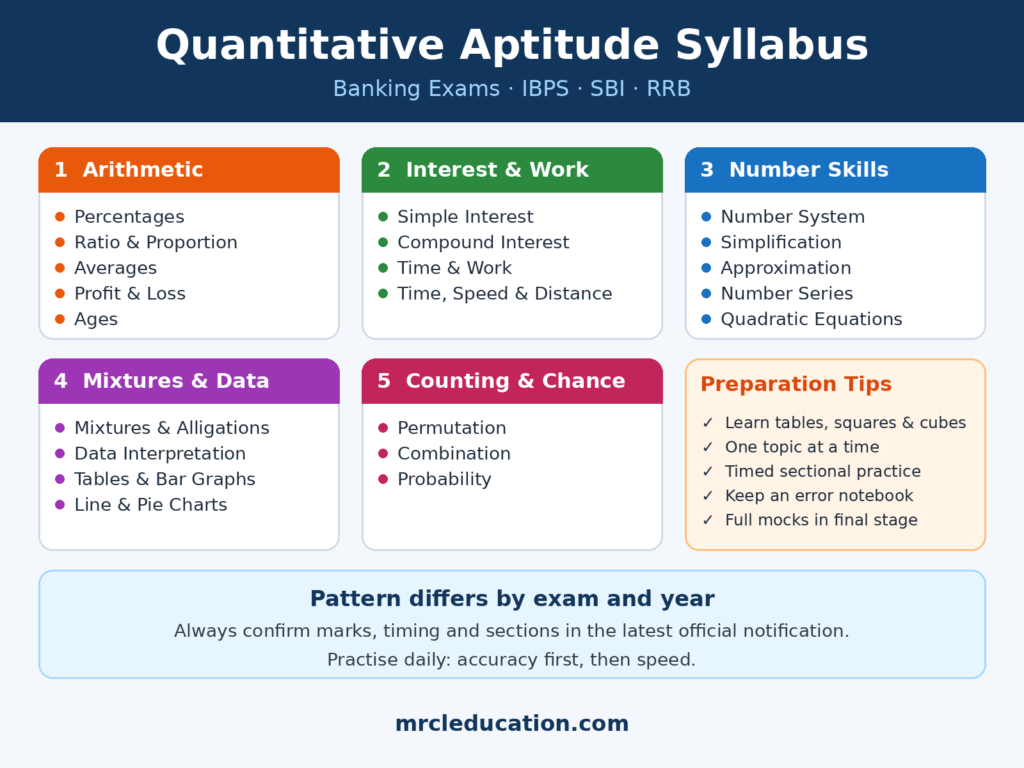
- Number system, simplification and approximation
- Percentages, ratio and proportion, averages
- Profit and loss, simple and compound interest
- Time and work, time, speed and distance
- Mixtures and alligations, ages
- Data interpretation (tables, bar graphs, line graphs, pie charts)
- Permutation, combination and probability
- Number series and quadratic equations
The following image clears about the topics being covered here along with clearing of the concepts.
How to Prepare for Quantitative Aptitude
- Fix the basics first. Learn tables up to 20, squares up to 30, cubes up to 15 and common fractions with their percentage values.
- Study one topic at a time. Learn the concept, solve solved examples, then practise 20–30 questions on that topic before moving on.
- Practise speed and accuracy. Attempt sectional timed tests. Don’t spend more than about a minute on a question you’re stuck on.
- Review your mistakes. Keep a notebook of errors and revisit it every week.
- Take full mock tests. Do this in the last stage, and analyze them properly.
Worked Examples of Quantitative Aptitude
Example 1 — Percentage. A number is increased by 20% and then decreased by 20%. What is the net change?
Take the number as 100. After a 20% increase it is 120. A 20% decrease of 120 is 24, so the result is 96. The net change is a 4% decrease.
Example 2 — Time and work. A can finish a job in 12 days and B in 18 days. How long will they take working together?
A’s one-day work is 1/12 and B’s is 1/18. Together they do 1/12 + 1/18 = 3/36 + 2/36 = 5/36 of the job per day. So the job takes 36/5 = 7.2 days.
Example 3 — Compound and simple interest. What is the difference between compound interest and simple interest on ₹10,000 at 10% per year for 2 years?
Simple interest = 10,000 × 10 × 2 / 100 = ₹2,000. Compound amount = 10,000 × (1.1)² = ₹12,100, so compound interest = ₹2,100. The difference is ₹100.
[Add one or two examples of your own here, ideally showing a shortcut you teach.]
Common Mistakes to Avoid in Quantitative Aptitude
- Attempting difficult questions first and running out of time.
- Guessing at approximation questions without estimating properly.
- Skipping data interpretation because the calculations look long.
- Not practising mental calculation.
Resources on This Site
https://mrcleducation.com/blog
Video Resources
Video resources on Quantitative Aptitude are available from the channel MRCL EDUCATION BY IITIAN. The link for the same is given here : https://www.youtube.com/@prml6473gmail-com
Frequently Asked Questions
Is Quantitative Aptitude difficult for beginners?
Not usually. The questions are based on school-level maths, so with regular practice most students improve steadily.
How many hours should I practise every day?
It depends on your time before the exam. Many students do one to two focused hours a day, but consistent daily practice matters more than long sessions.
Should I learn shortcuts?
Yes, but only after you understand the basic method. Shortcuts without the concept lead to mistakes.